
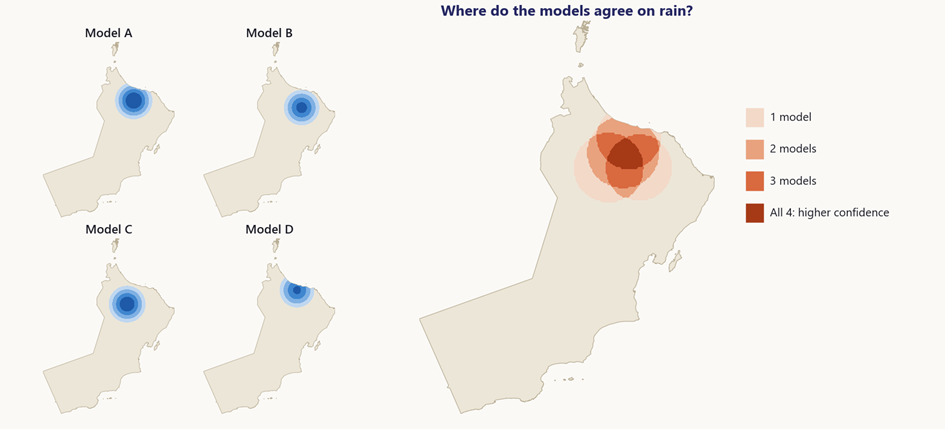
In an unsettled week, one model shows heavy rain over Muscat, another keeps the rain over the mountains, and a third shows almost nothing. Forecasters see this every day. Why do the models disagree, and what do forecasters do about it?
Which models do forecasters look at?
Forecasters in Oman compare several global models, run by major weather centres: the European Centre for Medium-Range Weather Forecasts (ECMWF), the American GFS, the UK Met Office model EGRR and the German ICON. They also use the Directorate’s own high-resolution models, which focus on Oman in more detail.
Why do they give different answers?
Each centre builds its starting picture of the atmosphere from observations in its own way, so no two models begin from exactly the same state. Each model also divides the world into squares of a different size, from a few kilometres to more than ten. Clouds and thunderstorms are smaller than most of these squares, so every model represents them with its own simplified rules. Over Oman’s mountains and coasts, these choices make a real difference. Finally, the atmosphere is chaotic: small differences grow day by day, so models usually agree more about tomorrow than about next week.
Is disagreement bad news?
No. It is information. When most models agree, forecasters can be more confident. When they disagree, the situation is genuinely uncertain, and the forecast should say so, for example with a chance of rain or a range of possible amounts.
Why not just pick the best model?
Because no single model is best every day. One may handle summer storms over the mountains better, another may handle winter troughs better. Over many days, combining several models usually gives better results than relying on any one of them.
How do forecasters use them together?
They compare the models side by side, look at where the models agree, check them against the latest satellite, radar and station observations, and use their experience of how each model behaved in past events. Some products combine the models into a single map showing where most of them agree on rain.
Sources: WMO, Guidelines on Ensemble Prediction Systems and Forecasting (WMO-No. 1091); ECMWF, Forecast User Guide.