
You open the forecast and see “40% chance of rain”. Will it rain over 40% of the country? For 40% of the day? Neither.
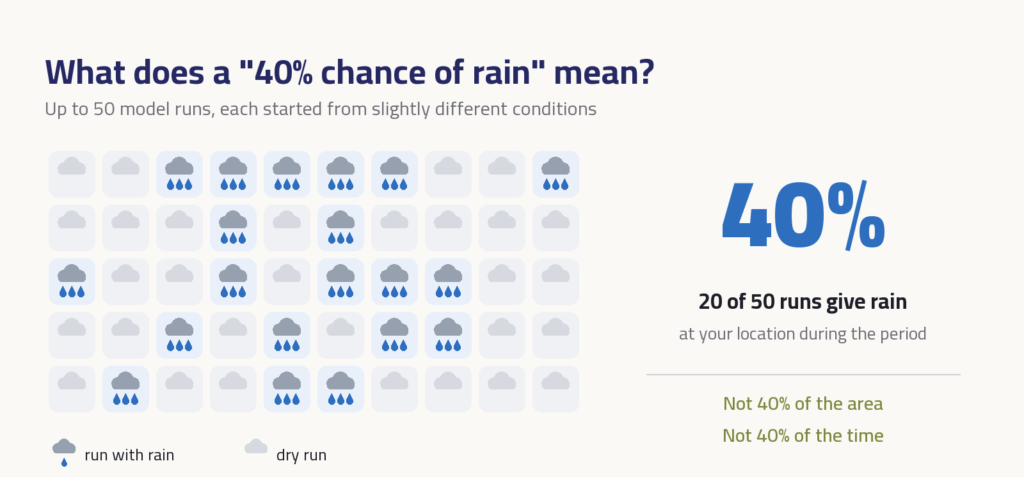
What does the number really mean?
It is the chance that rain falls at any given point in the forecast area during the stated period. A 40% chance means that on days with a forecast like today’s, rain would fall at your location on about 4 of every 10 such days. On the other 6, it would stay dry.
Where does the number come from?
Forecasters do not rely on a single model run. Weather centres run the same model many times, up to 50 times, each starting from slightly different conditions. This is called an ensemble. If 20 of 50 runs produce rain at your location, the chance of rain is 40%. Forecasters then combine several models with their own experience before issuing the final number.
Why not just say “rain” or “no rain”?
The atmosphere is chaotic. Small errors in today’s observations grow into large differences a few days ahead. A summer storm over Al Hajar Mountains can form over one valley and miss the next. A probability is the honest answer: it tells you how confident the forecast is.
How should I use it?
Think about what is at stake, not only about the number. A 20% chance of a heavy thunderstorm still matters if you plan to camp in a wadi or cross one by car. A 70% chance of a light shower may not change your plans at all. For high-impact activities, act on lower probabilities, follow the official warnings, and check the forecast again as the day approaches, because the numbers change as new observations arrive.
The short version
A 40% chance of rain is not a failed forecast when it stays dry, and not a broken promise when it rains. It measures how sure forecasters are, and it helps you decide how much to prepare.
Sources: WMO, Guidelines on Communicating Forecast Uncertainty (WMO/TD-No. 1422); ECMWF, ensemble forecasting.