
Introduction
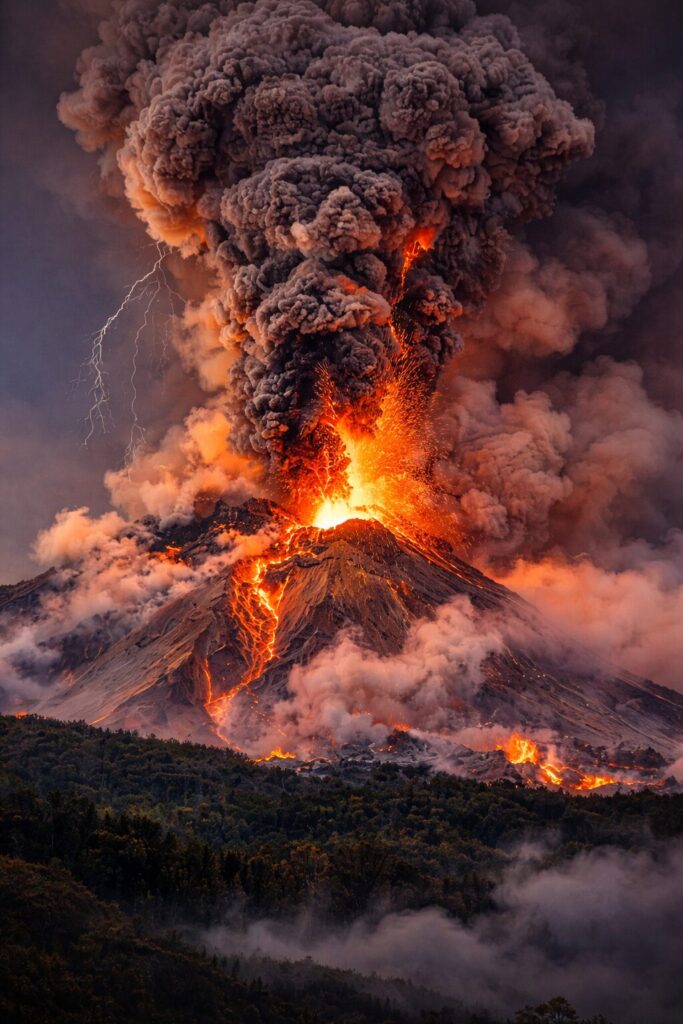
Volcanic ash is one of the most prominent byproducts of volcanic eruptions. It consists of fine particles released into the atmosphere as a result of volcanic explosions or collapses. Although the Sultanate of Oman does not have active or dormant volcanoes, it may occasionally be affected by volcanic ash transported from distant regions, particularly from volcanoes in East Africa or from dormant volcanic areas in parts of the Arabian Peninsula (which are rare in the current geological era). Volcanic ash possesses physical and chemical properties that enable it to affect air quality, human health, aviation, and climate.
First: What Is Volcanic Ash?
Volcanic ash consists of solid particles produced by the fragmentation of rocks, lava, and volcanic glass during an eruption. The particle size is typically very small, with diameters less than 2 mm, and some particles may be only a few microns in size. These particles are often sharp, glass-like fragments formed from molten rock. Their light weight allows them to rise into the upper layers of the atmosphere and travel hundreds or even thousands of kilometers.
Second: How Is Volcanic Ash Formed?
Explosive volcanic eruptions
When highly viscous, gas-rich magma (such as silica-rich magma) rises from deep within the Earth, pressure builds up inside the volcanic conduit, leading to a sudden explosion. During the eruption, rocks and lava are shattered into fine ash particles that are ejected into the air in the form of volcanic ash clouds. This mechanism is the primary source of the largest ash plumes.
Interaction between magma and water
When magma comes into contact with water, rapid vaporization occurs, generating high pressure due to steam expansion, which causes explosive fragmentation of the magma. This process produces large quantities of extremely fine volcanic ash.
Mechanical fragmentation of lava
When lava flows rapidly over rocky surfaces, its edges break due to friction, contributing to the production of volcanic ash, though in smaller quantities compared to explosive eruptions
Third: Long-Distance Transport of Volcanic Ash
High temperatures during eruptions can lift ash into the upper layers of the atmosphere, sometimes reaching altitudes between 10 and 40 km. The higher the ash rises, the farther it can spread and the longer it can remain suspended in the atmosphere.
Several factors control ash movement:
- Wind direction in the upper atmospheric layers
- The duration that ash remains airborne
Fourth: Environmental and Health Impacts of Volcanic Ash
Impact on human health
- Eye and respiratory irritation
- Increased asthma and allergy symptoms
- Fine particles, especially those smaller than 2.5 microns (PM2.5), can penetrate deep into the lungs
- Ash may contain chemical substances such as sulfur, fluorine, and heavy metals
Impact on aviation
Volcanic ash poses a serious hazard to aircraft. Fine glass-like particles can melt inside jet engines due to high operating temperatures, potentially causing engine failure. Ash can also disrupt navigation systems and significantly reduce visibility, affecting flight routes and international air traffic.
Impact on agriculture
- Ash deposition on plant leaves reduces photosynthesis
- It may alter soil acidity
- In some long-term cases, ash can benefit soil fertility due to its rich mineral content
Fifth: Can the Sultanate of Oman Be Affected by Volcanic Ash?
Indirect impact (most common)
Oman may be affected by very small amounts of volcanic ash transported from:
- East Africa (Ethiopia and Eritrea)
- Turkey
- Parts of the Arabian Peninsula (rare in the current geological era)
This occurs when:
- Upper-level winds are directed toward the Sultanate of Oman
- A major eruption injects ash columns into the stratosphere
How can it be observed in Oman?
- Volcanic ash is usually not as noticeable as typical dust events. It may appear as a layer of atmospheric haze caused by extremely fine particles in the upper atmosphere.
Sixth: Preventive Measures in the Event of Volcanic Ash Arrival
For the public:
- Wearing face masks
- Avoiding outdoor activities for asthma patients
- Closing windows
For the aviation sector:
- Issuing warnings
- Rerouting air traffic
For health authorities:
- Increasing the readiness of emergency departments to handle asthma cases
Volcanic Ash Events Affecting the Sultanate of Oman
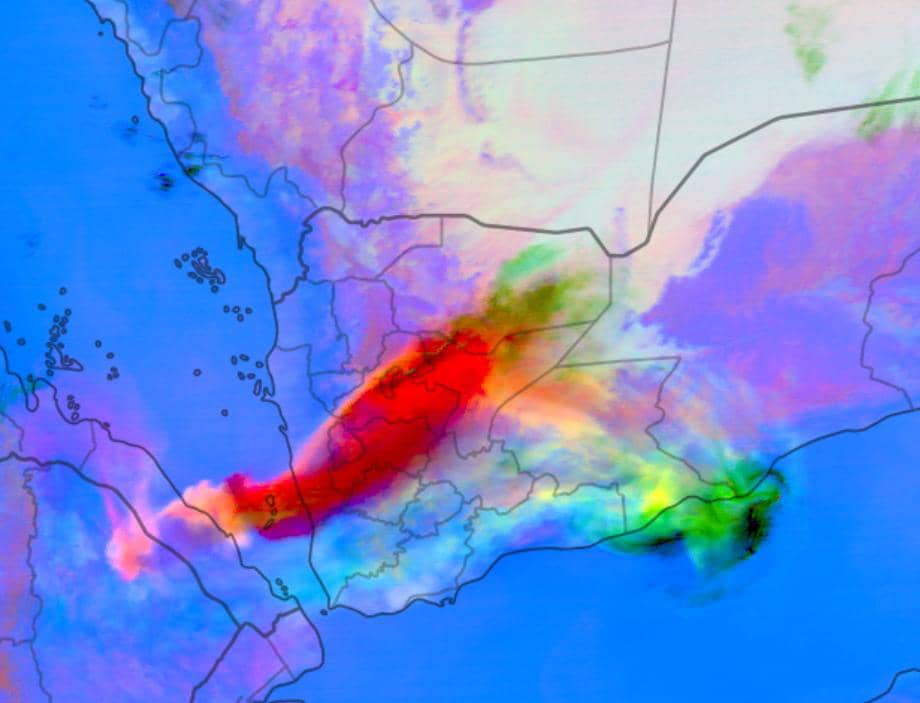
The airspace of the Sultanate of Oman was affected by a volcanic ash event resulting from an eruption in Ethiopia. The volcanic cloud traveled until it reached the southern parts of Oman, primarily in the upper atmospheric layers (attached volcanic cloud imagery).
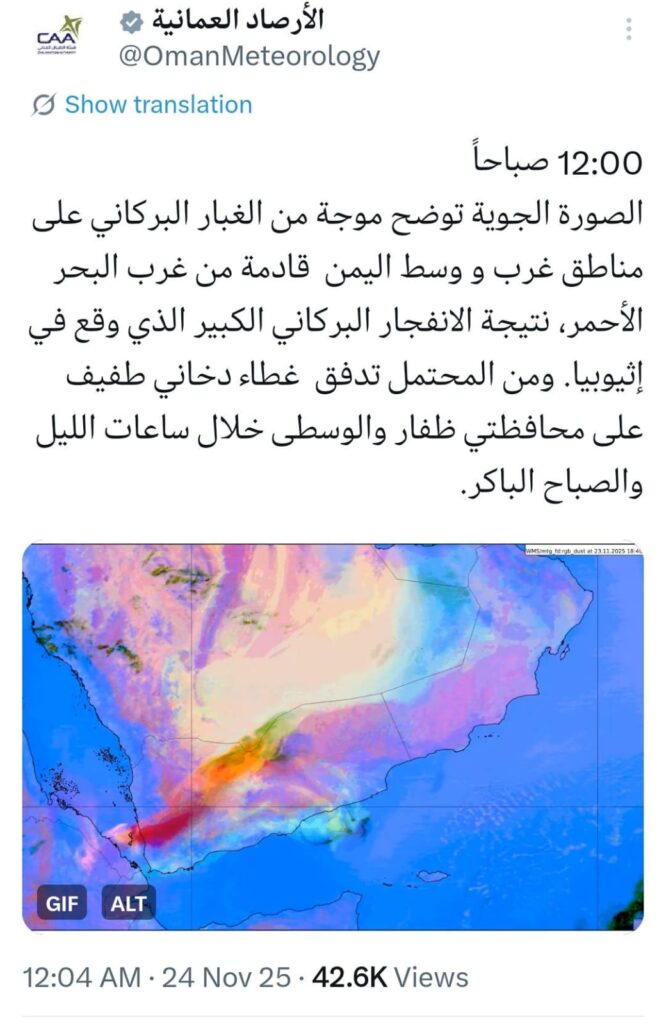
The National Early Warning Center also issued alerts regarding the potential impacts through the X platform (attached).
A video illustrating the spread of volcanic ash is attached.
Conclusion
Volcanic ash is a natural phenomenon resulting from volcanic eruptions and can travel tens of thousands of kilometers due to upper-level atmospheric winds. Although the Sultanate of Oman is distant from major volcanic activity zones, it may still be indirectly affected, particularly in the upper atmosphere. This can influence air quality and aviation without causing significant surface-level damage. Monitoring volcanic ash is therefore an essential responsibility of meteorological and civil aviation authorities to ensure public and aviation safety.