
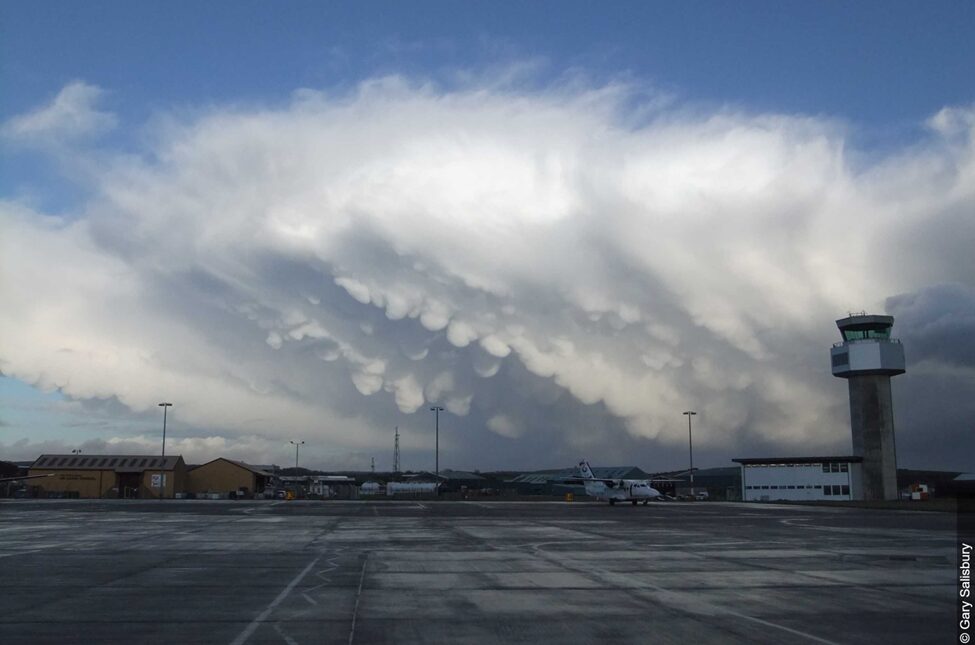
After a strong thunderstorm, the sky over Oman can transform into something extraordinary – smooth, pouch-like shapes hanging from the base of a cloud, as though the sky itself is blistering. These are mammatus clouds, one of the most visually striking formations recognised in the WMO International Cloud Atlas.
How do they form?
Nearly all clouds form when warm air rises, cools, and condenses. Mammatus clouds are different – they form through descending air, making them one of the few cloud types that grow downward.
- A mature thunderstorm builds up – A large cumulonimbus cloud accumulates dense concentrations of ice crystals and heavy water droplets near its anvil – the flat, spreading top of the storm.
- Cold, heavy air begins to sink – This saturated, cold air is denser than the air around it and starts descending from the cloud base toward the surface.
- Pouches form where sinking air meets dry air below – As the descending pockets encounter the drier layer beneath the cloud, they take on their characteristic rounded, bubble-like shape – the mammatus lobes.
What they tell us?
- A sign of strong atmospheric instability. Their presence signals powerful turbulence and vertical motion in the upper atmosphere – conditions that accompany severe convective weather.
- Associated with severe thunderstorms. Mammatus nearly always appear beneath the anvil of a cumulonimbus.
- If you see them, heavy rain, lightning, or intense downdrafts may be nearby or have just passed through.
They are a photographer’s dream, their textured forms catch low-angle light beautifully. At sunrise or sunset, they can produce deeply coloured, dramatic skies unlike any other cloud type.
Should you be concerned?
Mammatus clouds are not dangerous on their own – but they are the atmosphere’s way of showing its hand. If you see them over Oman, enjoy the view from a safe location and stay alert to official weather updates.
Sources: https://cloudatlas.wmo.int/en/clouds-supplementary-features-mamma.html
https://cloudatlas.wmo.int/docs/wmo_407_en-v2.pdf