
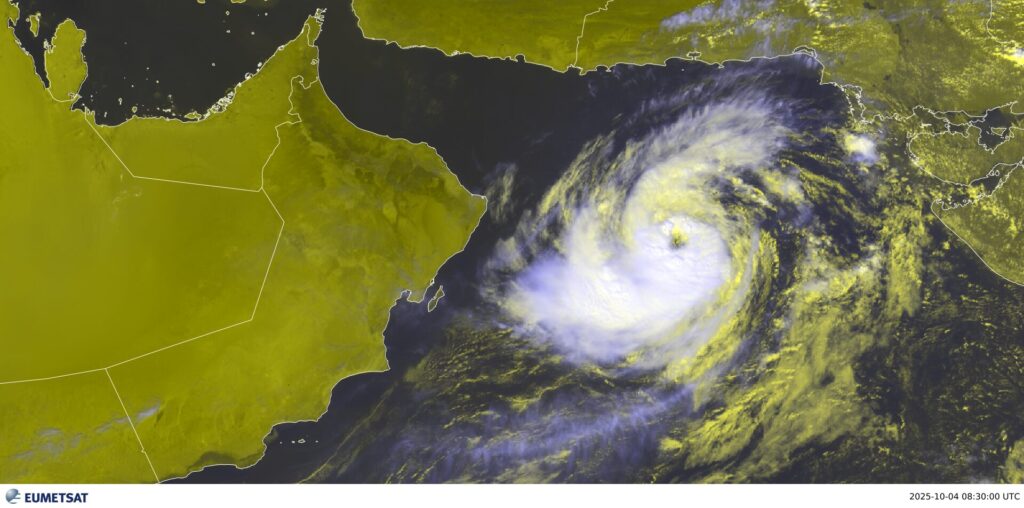
During early October 2025, meteorological centres monitored Tropical System “Shakti” over the Arabian Sea as it evolved through several stages of development and weakening. Although the system remained over the sea, it indirectly affected parts of the Sultanate of Oman through cloud advection, scattered rainfall, and sea level rise along some coastal areas.
Development Stages of Tropical System
The Tropical System “Shakti” developed from a tropical disturbance over the northeastern Arabian Sea along the Indian Coast on 28 September. It intensified into a tropical depression on 2 October, then into a deep depression on 3 October, before rapidly developing into a tropical storm later that day and reaching Category 1 tropical cyclone on 4 October. After reaching its peak intensity, the system began to gradually weaken. It downgraded to a tropical storm on 5 October, then a deep depression on 6 October, and subsequently to a tropical depression on 7 October.
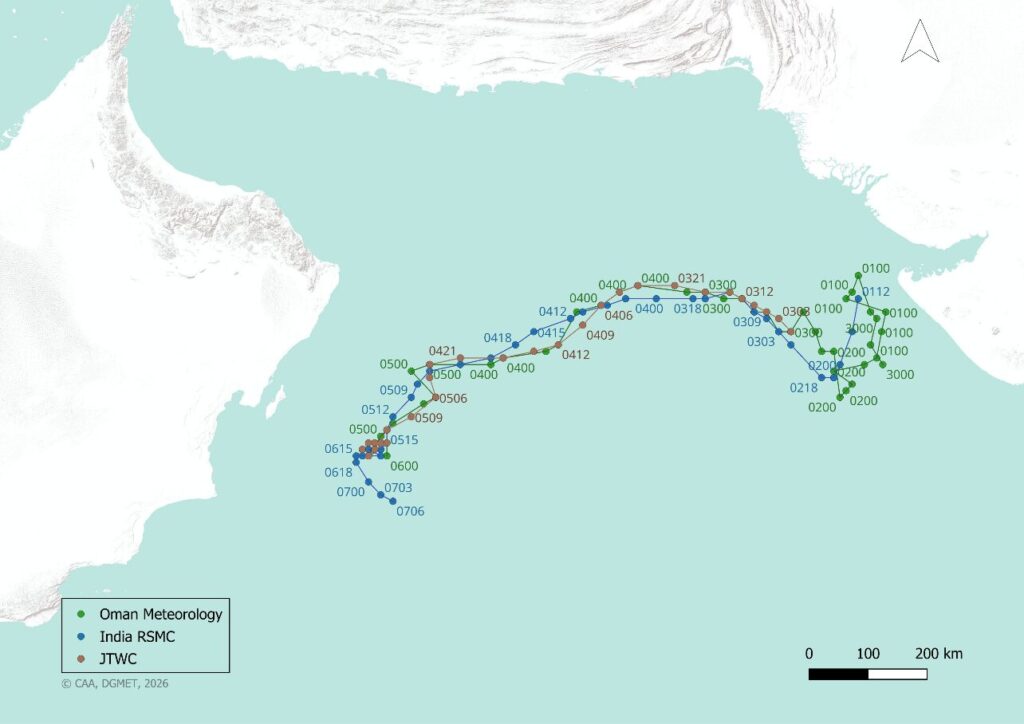
Track of the Tropical System
The tropical system was moving southwestward toward the southeastern coasts of Oman before veering southeastward over the Arabian Sea from 6 October. It exhibited limited oscillation in its movement due to its gradual weakening. This weakening resulted from its interaction with upper-air currents and wind shear in the mid-upper troposphere (200-500 hPa). As a consequence, the system drifted southward and then southwestward over the Central Arabian Sea, while continuing to weaken as a low-pressure system before its dissipation.
Impacts of the Tropical System
The impacts of Tropical System “Shakti” were indirect and included cloud advection over the coastal areas of Al Sharqiyah South, Al Wusta, and Dhofar governorates, leading to scattered rain.
The system was also accompanied by sea level rise and inundation of seawater into low-lying coastal areas and inlets, coinciding with high tides
Comparison of Classification among Meteorological Centres
A discrepancy was observed in the classification of the tropical system “Shakti” among Oman Meteorology, the India Regional Specialised Meteorological Centre (RSMC), and the Joint Typhoon Warning Centre (JTWC), as well as satellite-based Dvorak intensity estimates. However, a high level of consistency was observed between Oman Meteorology and the India RSMC across most classification stages. On the other hand, a clear difference was noted with JTWC, which was quicker to upgrade the system to a tropical cyclone than other centres.
The Dvorak estimates, and JTWC agreed in classifying the system as a tropical storm during the early stages, whereas Oman Meteorology and the India RSMC maintained a deep depression classification during that period.
However, agreement was observed between Oman Meteorology and the Dvorak estimates when the system was classified as a Category one Tropical cyclone. During the weakening stages, all centres reported a decrease in the system’s intensity with some differences in the estimated wind speeds.
This variation in the classification of the tropical system “Shakti” across centres can be attributed to differences in surface wind speed estimation methodologies and the classification criteria adopted by each centre.
| Date | UTC | Oman Meterology | India RSMC | JTWC | Dvorak estimates |
| 30/9 | 11:00 AM | Tropical Depression (20-27 knots) | Tropical Depression (15-20 knots) | Tropical Depression (25 knots) | T1.0 – Tropical Depression (25 knots) |
| 2/10 | 11:15 AM | Tropical Depression (20-27 knots) | Tropical Depression (25 knots) | Deep Tropical Depression (30 knots) | T2.5 – Tropical Depression (30 knots) |
| 3/10 | 4:30 AM | Deep Tropical Depression | Deep Tropical Depression (30 knots) | Tropical Storm (35 knots) | T3.0 – Tropical Storm (45 knots) |
| 3/10 | 10:50 AM | Tropical Storm | Tropical Storm (35-40 knots) | Tropical Storm (40-45 knots) | T3.0 – Tropical Storm (45 knots) |
| 4/10 | 11:00 AM | Tropical Storm (45-55 knots) | Severe Tropical Storm (55 knots) | Tropical Cyclone (1) (55-65 knots) | T3.0 – Tropical Storm (55 knots) |
| 4/10 | 9:00 PM | Tropical Cyclone (1) (64-70 knots) | Severe Tropical Storm (55-60 knots) | Tropical Cyclone (1) (70-75 knots) | T4.0 – Tropical Cyclone (1) (55-77 knots) |
| 5/10 | 11:00 AM | Tropical Storm (40-55 knots) | Severe Tropical Storm (55-60 knots) | Tropical Cyclone (1) (60-64 knots) | T4.0 – Tropical Cyclone (1) (77 knots) |
| 6/10 | 06:45 AM | Deep Tropical Depression (28-33 knots) | Tropical Storm (35-45 knots) | Tropical Storm (40 knots) | T3.0 – Tropical Storm (35-45 knots) |
| 6/10 | 11:00 AM | Deep Tropical Depression (28-33 knots) | Tropical Storm (35-45 knots) | Tropical Storm (35-40 knots) | T2.5 – Tropical Storm (35 knots) |
| 7/10 | 06:45 AM | Tropical Depression (17-27 knots) | Tropical Depression (20 knots) | – | – |
Conclusion
Tropical System “Shakti” was characterized by gradual development and weakening over the Arabian Sea, with indirect impacts on the Sultanate of Oman. Differences were observed in the classification, and intensity estimates among meteorological centres due to variations in analysis methods and wind estimation techniques. Despite these differences, the system was monitored closely throughout its lifecycle, and overall agreement was observed regarding its general track and weakening trend.