
Introduction:
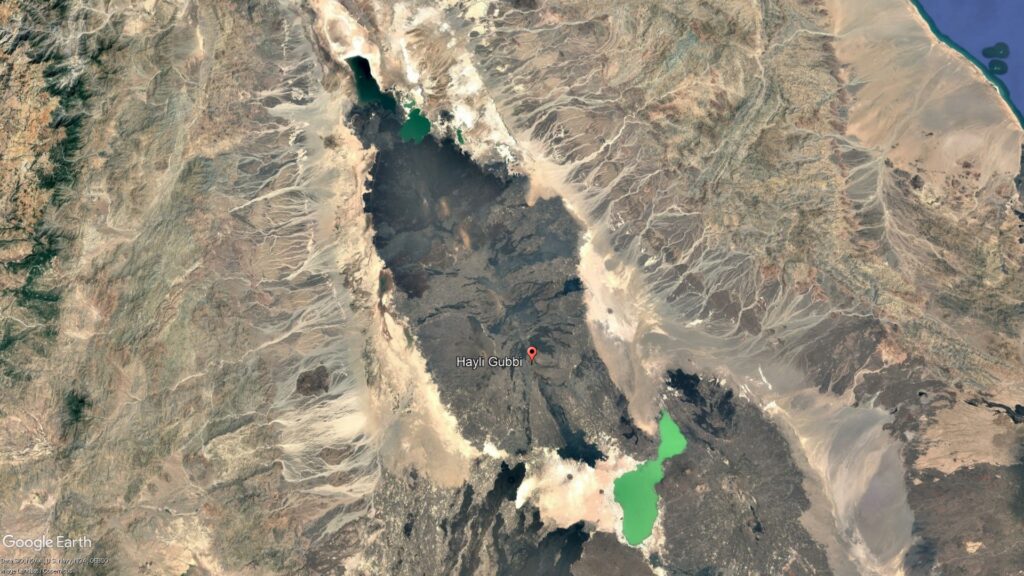
Hayli Gubbi is a dormant volcano in northeastern Ethiopia. After being quiet for nearly 10,000 years, it suddenly erupted on 23 November 2025. The eruption sent ash and gas high into the atmosphere, reaching 15 km altitude. It was one of the strongest volcanic events in the region in recent history.
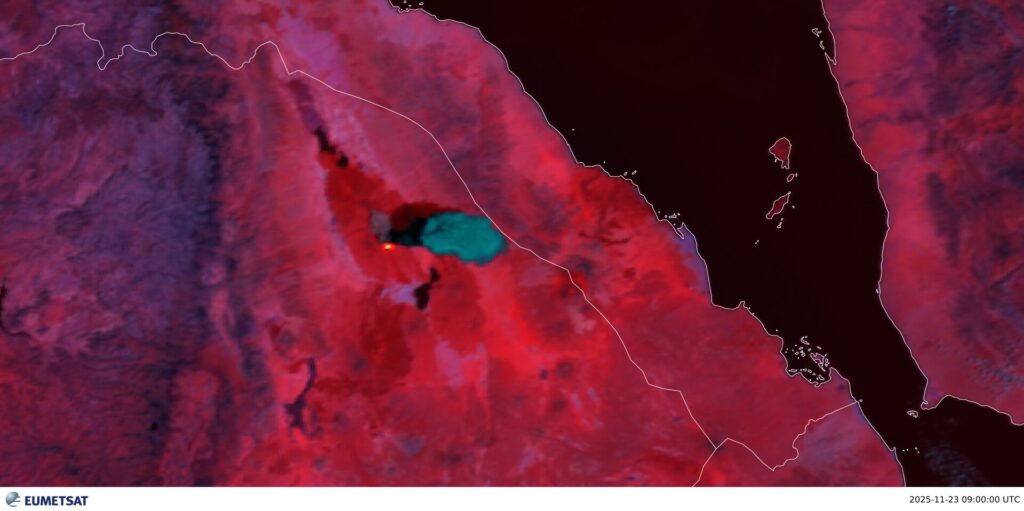
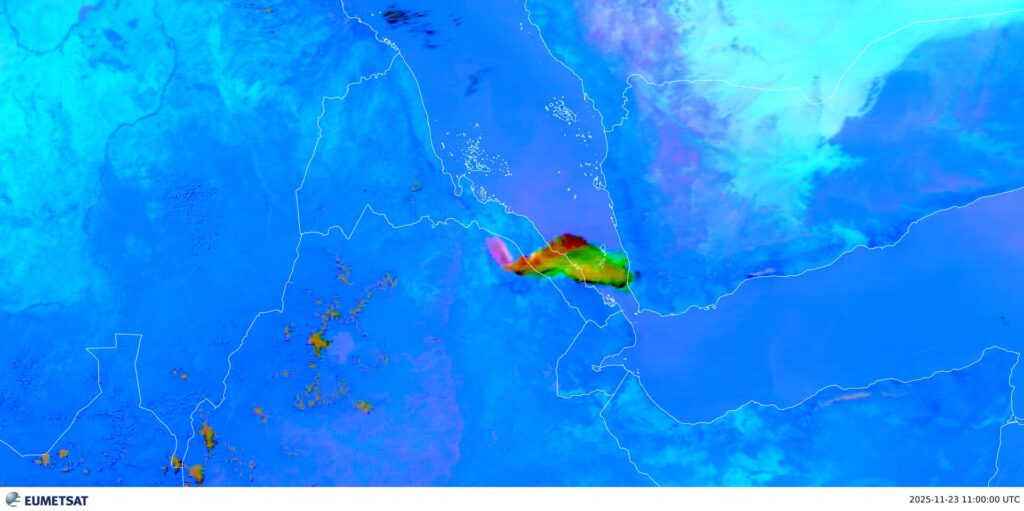
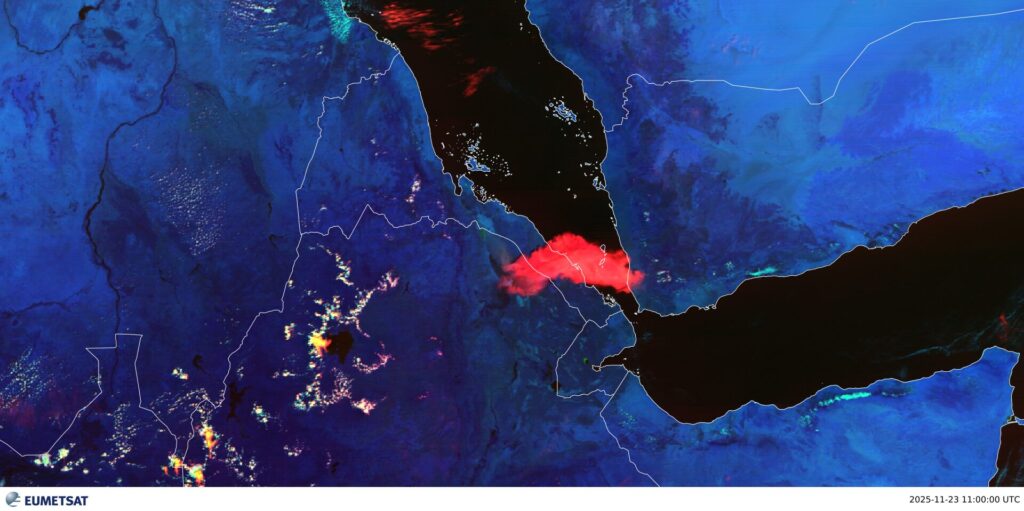
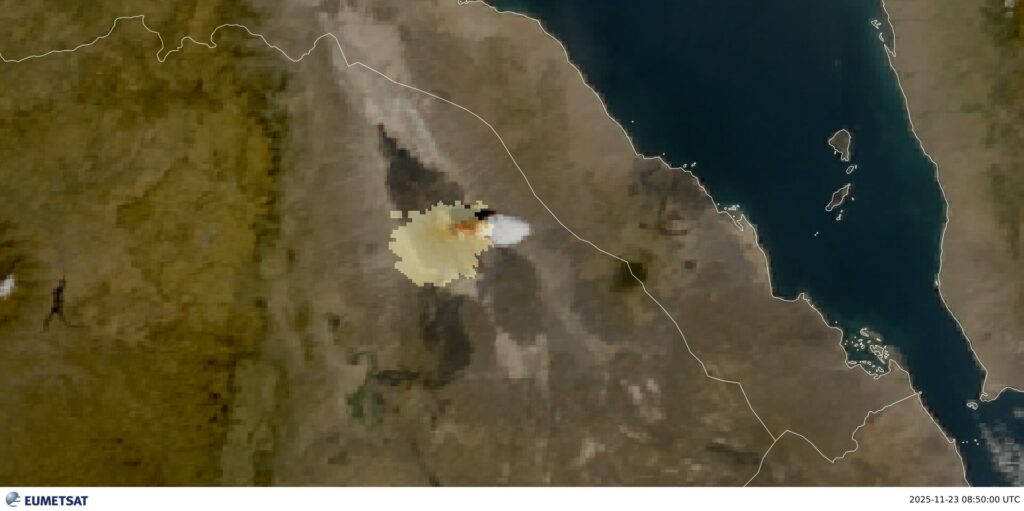
23 Nov 2025– Initial Explosion: At around 08:30 UTC, a powerful explosion sends a massive ash cloud high into the atmosphere, immediately captured by satellite sensors. Fire RGB (Fig. 1) reveals a bright yellow core marking the hottest area at the vent, surrounded by a cooler red ring. In Dust RGB (Fig. 2), the ash appears in striking red tones as it spreads outward, while green areas point to SO₂ emissions. The plume quickly rises into the upper stratosphere, which appears in Cloud Type RGB (Fig. 3) as deep red tones marking its highest parts. During this early phase, lightning detections (Fig. 4) confirm strong electrical activity within the ash cloud.
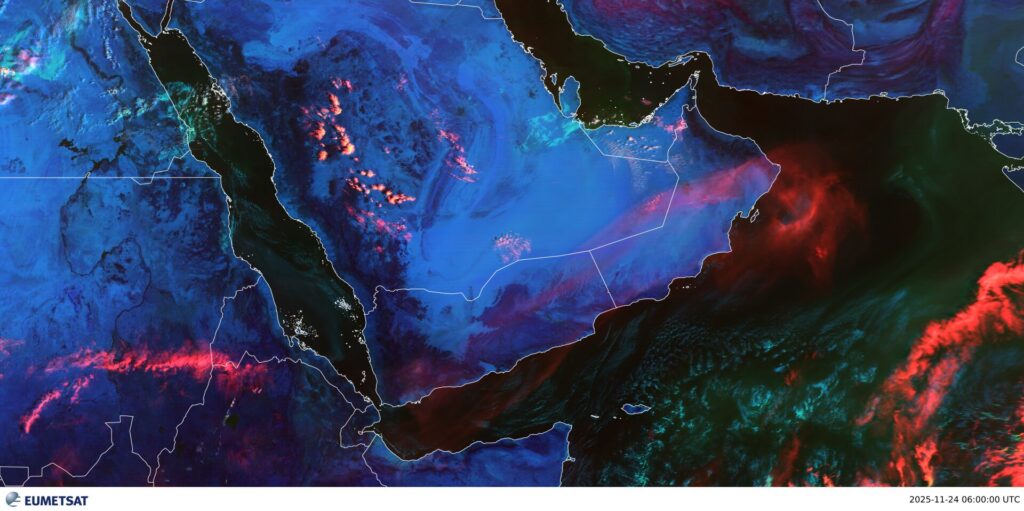
24 Nov 2025 – Eastward Drift: As monitoring continues, satellites track the ash moving steadily eastward. The plume passes over Yemen on 23 Nov, a path clearly shown in Dust RGB (Fig. 5), before continuing its journey toward Oman, which it reaches on 24 Nov. Throughout this movement, Cloud Type RGB (Fig. 6) shows faint red at the plume’s top, indicating that the ash remains at high altitude as it crosses the region.

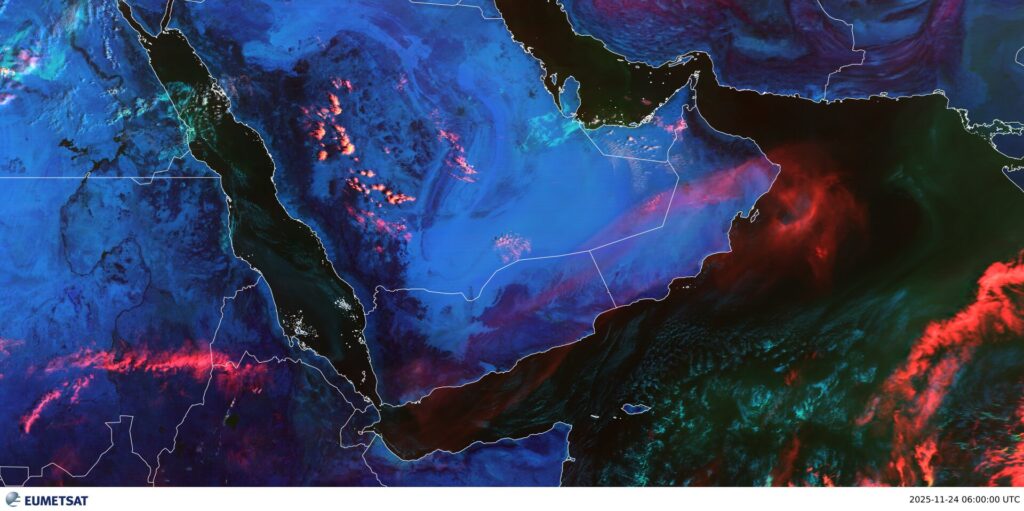
25 Nov 2025 – Residual Drift: By the following day, the eruption has largely subsided. Even so, thin layers of ash and SO₂ continue drifting eastward toward South Asia, gradually dispersing as they travel farther from the source.
Impact on Oman
The following summarizes key observations and consequences of the eruption.
- Weather and Air Quality Monitoring: The ash stayed high in the sky and did not affect ground-level air. The Environment Authority (EA) confirmed that air quality in Oman stayed normal throughout the event. To monitor conditions, the EA used its network of 68 Naqi air-quality stations, which detected no harmful gases or particles at ground level.
- Flights and Aviation: The Civil Aviation Authority (CAA) coordinated with international partners and airlines across the Middle East, leading some carriers to adjust or cancel certain flight routes. Airlines monitored the situation closely, and once the high-altitude volcanic cloud had passed the region, airports in Oman resumed normal operations. Overall, the precautionary measures resulted in some delays and rerouted flights, but no aircraft in Oman’s lower airspace were affected by volcanic ash.
Conclusion:
The Hayli Gubbi eruption of 23 November 2025 was a rare and powerful event, remarkable both for its intensity and for the clarity with which it was monitored by modern satellite systems. Although the ash plume reached exceptional heights and spread across several countries, its impact on Oman remained minimal due to its high-altitude trajectory and the effective coordination between national and international agencies. Continuous satellite tracking, air-quality monitoring, and proactive aviation advisories ensured that risks were well managed throughout the event. The eruption ultimately highlighted the critical role of remote sensing and early-warning systems in safeguarding public safety, air travel, and environmental health during large-scale volcanic episodes.